

The noblest of horses. The Thoroughbred is today the reigning breed in the equine world. Valued for their speed and ability to excel, these animals generate billions in wealth. And, although their origins and crossbreeding are nowadays studied with great care, there are still many legends and false beliefs about their origins. Let’s dive today into the legend of the king of kings.
The Thoroughbred (TB) is today one of the best known and most valued breeds in the world. The TB is not only the fastest horse and king of the racetracks, but it is also the founding breed of all the sport studbooks we know today. Thus, the best horses in the best known and most demanding disciplines (racing, jumping, dressage or eventing) are or descend directly from this breed.
But where was the TB born and how did the legend originate? The history of this breed is closely linked to the world of horse racing and the British Isles. Horse races have been held in the United Kingdom since at least 1174 (Smithfield, near London). And, in the second half of the 16th century, handicap races were already being held. But the term “thoroughbred” did not appear until 1713.
What happened in the late sixteenth and early seventeenth centuries to give birth to a race for a sport that, on the other hand, already existed centuries before? First of all, although it is true that racing was popular in the islands, it was not until the reign of Charles II (1649-1651) that the sport gained royal support and grew exponentially.

But, and what is more relevant here, between 1680 and 1730 a series of stallions and mares were imported from the Middle East that would change the history of racing forever. Today we will focus on studying the three most influential («Byerley Turk», «Darley Arabian» and «Godolphin Arabian») but we cannot forget that they were not the only ones. Other sires such as «Alcock’s Arabian», «D’Arcey White Turk», «Leedes Arabian» or «Curwen’s Bay Barb» were also responsible for the foundation of the TB. For example, today we know that the G gene (the one that produces the dapple coat) was introduced into the TB thanks to the stallion «Brownlow Turk».
These stallions were crossed with local mares (usually Irish) and, to a lesser extent, also with Middle Eastern mares imported for this purpose.
But what breed were these animals? Researcher Peter Willet argues that 50% of the founding stallions were of Arabian breed. This hypothesis has survived to the present day and remains in our collective unconscious.
However, a 2020 study, led by Cosgrove, rejects Willet’s idea. This group of researchers, after studying the origins of almost 400 Arabian horses, demonstrated that the influence of these animals in the foundation of the TB is minimal. And that, although today, TB horses show a percentage of Arabian blood that can reach up to 62%, the influence of the Arabians in the racehorse comes from the crosses made in later years; and does not descend directly from these foundational stallions.
Be that as it may, the dominance of these horses (whatever their breed) is undeniable. For example, «Darley Arabian» is responsible for 95% of today’s thoroughbred male lines. However, if we take into account both male and female bloodlines, the influence of this sire drops to 6.5% and “Godolphin Arabian” becomes the leading sire of the breed; his blood is present in 13.58% (although other studies speak of 13.80%) of modern TB. The third most influential founding sire would be “Curwen’s Bay” (4.2%) surpassing “Byarley Turk” (3.3%).
Curiously, the three great founding stallions (“Darley”, “Godolphin” and “Byerley”) did not have long descendants, despite their popularity at the time. And today they have come down to us thanks to a single line per stallion. Thus, “Byerley” is present through “Herod”. “Godolphin” does the same with ‘Matchem’ and, finally, the blood of ‘Darley’ survives thanks to the eternal ‘Eclipse’.
BYERLEY TURK (1680-1703) The War Horse

It is still unclear how “Byerley Turk” came to the islands. Some sources argue that the animal was captured by Colonel Byrley at the Battle of Buda (1686). While other researchers consider that Byerley got hold of it after the battle of Vienna (1683). Finally, there are those who postulate that “Byerley Turk” was born in the United Kingdom, the son of imported horses.
Be that as it may, the early years of this Turkmenistan horse (although some sources refer to him as an Arab) were linked to the war. Colonel Byerley’s favorite mount, the military man himself admitted that his companion’s speed saved his life on more than one occasion.
When the Colonel married and retired, «Byerley Turk» followed suit and became a stallion in his owner’s stables. This Turkish horse had few offspring, but of great quality. Among his offspring were horses such as “Black Hearly”, “Grasshopper” (winner of the Town Plate) or “Jigg” (grandsire of the aforementioned “Herod”).
But, without a doubt, the best offspring of “Byerley Turk” came from his daughters. An unnamed mare, daughter of this stallion, was the founder of TB line 1. Today present in more than 15% of modern thoroughbreds, line 1 is one of the most prestigious in the breed: it has more than thirty winners of the Epsom Derby or the St. Leger and “Frankel” is a direct descendant of this lineage.
“Bowes Byrley Turk”, another daughter of the Turk sire, was founder of line 3. And other descendants of “Byerley Turk” are also dams of lines 8, 17 and 41.
DARLEY ARABIAN (1700-1730): the Syrian roots of “Eclipse”.

In chronological order, the second founding stallion was the Arabian “Darley Arabian”. Interestingly, I have not found any ancient writings questioning the breed of this stallion.
“Darley Arabian” was purchased around 1704 by Thomas Darley in Aleppo (Syria). Darley was the British ambassador in those lands and he fell in love with a colt with a chestnut coat and incredible morphology. Legend has it that he paid some 300 gold coins for him and, despite the incredible booty, the local sheikh found it hard to get rid of his best foal.
This Arabian horse was an agile animal, well built but not very tall (15 hands, just over 1.50m). As a stallion, he sired the undefeated «Flying Childers» and his own brother «Bartlett’s Childers». The latter never raced but left his mark on the TB world through his great-grandson “Eclipse”.

«Eclipse» (1764-1789), undefeated in his eighteen starts (including eleven King’s Plates), this true champion is directly responsible for horses such as «Northern Dancer», «Mr. Prospector», «Sadler’s Wells», «Danehill», «Galileo», «Secretariat», «Storm Cat», «Tapit» and «Deep Impact». Or, in other words, sire of the most relevant stallions from the four corners of the globe. The skeleton of “Eclipse”, by the way, is kept at the Royal Veterinary College in Hertfordshire.
But back to “Darley Arabian”, this Arabian stallion not only managed to sire the “Eclipse” line. Despite covering few mares, he was able to sire great runners such as “Almanzor”, “Aleppo”, “Cupid”, “Brisk” or Draedalus”… And, in addition, his son ‘Blue Rock’ was the first PSI exported to the United States (1730).
Today, HH Sheikh Mohamed bin Rashid Al Maktoum continues to honor this stallion thanks to his elite breeding center, named Darley, after the great-great-grandfather of “Eclipse”.
GODOLPHIN ARABIAN (1724-1753): a globetrotting horse
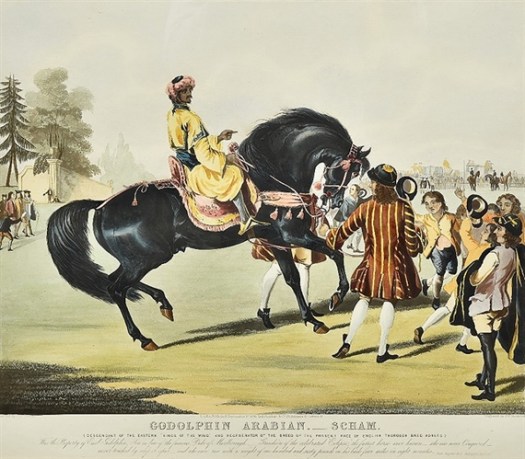
Finally we come to the great “Godolphin Arabian”. Born in 1724 in Yemen, he was imported to Syria as a foal and later given as a gift to the French King Louis XV (1730). The French must not have been very pleased with this horse of graceful movements and robust neck; for they rejected him as a saddle horse and poor “Godolphin Arabian” spent his days pulling a cart.
Sometime in the 1730’s, he was imported to the United Kingdom. There he acquired his definitive name thanks to Francis Godolphin, his most famous and distinguished owner.
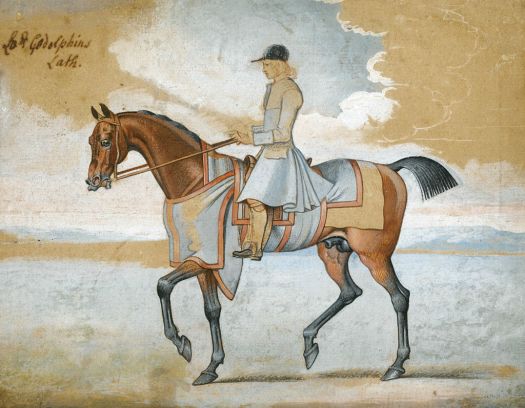
Curiously, although the past of “Godolphin Arabian” is quite well documented, we are probably dealing with a stallion whose origins bring the most headaches. Historically, this horse has always been considered an Arabian. In the pictures of the time, we can clearly distinguish the morphology of the breed.
In addition, Francis Godolphin, who owned the animal for much of its life, always referred to it as an Arabian horse. However, the book “History of the British Turf” (1840) defines the horse as “Godolphin Barb, erroneously known as Godolphin Arabian….”. The name “barb” refers to the Berber horses, a breed originating in North Africa and closely related to the Arabian thoroughbred.
Likewise, the surname “Turk” (mentioned in the section on “Byerley Turk”) congregates animals of the Turk breed. These three breeds had great physical similarities but, genetically, they are very different animals.
Part of the confusion may come from the vagueness of the terms. For example, although today we clearly define each of these breeds, at the time it was common to refer to a “Turkish” horse as an animal from Arabia or Persia. Therefore, we could easily be talking about a horse genetically Arabian but named after another breed.
But, on the other hand, and as already mentioned, the most modern studies defend that the founding stallions of the Throughbred studbook were Berbers and not Arabs, which would give strength to the theory of the “History of the British Turf”.
Be that as it may, “Godolphin Arabian” was a chestnut-coated stallion that stood out for his fine physique and his incredible neck. In addition, he had a rather modest height (1.52m) which aroused the distrust of local breeders. At that time (although I’m afraid things have not changed that much) breeders preferred taller and more robust stallions. So poor “Godolphin Arabian” not only received no suitors, but had to work as a scout, checking if the mares were receptive to other stallions.
Everything changed thanks to the stubborn “Lady Roxana”. This mare was going to be covered by another of the local stallions but, due to her bad character, it was not possible to carry out the mating. The mare’s owner then decided to cover her with “Godolphin Arabian”. «Lath” was born from the crossbreeding and, with him, a legend. “Lath” raced nine times, winning each and every one of his starts.
After “Lath”, “Godolphin Arabian” gained popularity among British breeders and, little by little, made a place for himself in the breeding of the islands. So much so that this horse became the champion of the 1738, 1745 and 1747 stallion statistics.

Godolphin Arabian’s imprint can still be seen on our tracks. «Seabiscuit”, ‘Man O’War’, ‘War Admiral’, ‘Tiznow’, ‘Known Fact’ (winner of the 2000 guineas) ‘Diktat’ or ‘Dream Ahead’ are direct descendants of our protagonist.
In addition, “Godolphin Arabian” is grandsire (by maternal line) of the aforementioned “Eclipse”. It is curious to see how we give prestige to paternal lines to the detriment of maternal lines. «Eclipse” will always be mentioned as a creation of the ‘Darley Arabian’ line when it is fair to admit that this stallion appears in the fourth generation of the ‘Eclipse’ tree; while ‘Godolphin Arabian’ is in the second generation.
Today, moreover, Godolphin is the name of one of the most important stables in the world. Managed, once again, by HH Sheikh Mohamed bin Rashid al Maktoum, the blue of Godolphin competes in the most important races on the world calendar.
 Woman O'War